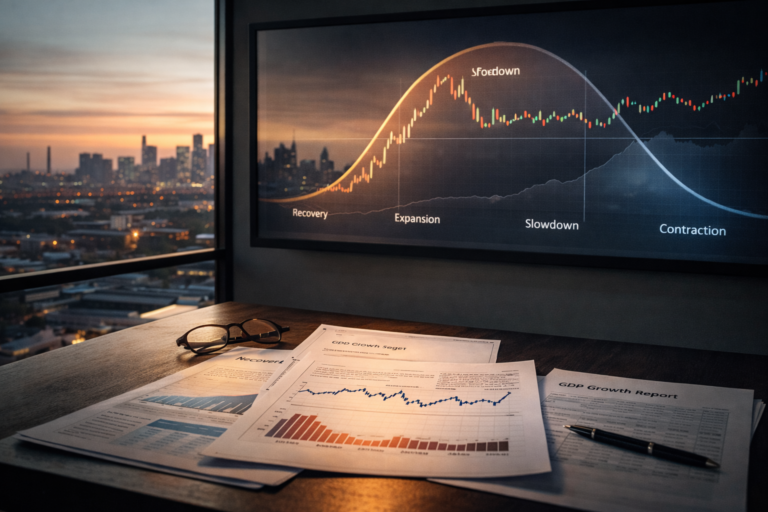
Fundamental vs technical analysis in forex explains the difference between why currency prices move and how those moves appear on price charts. In foreign exchange markets, currencies respond to macroeconomic forces, policy expectations, and global capital flows, while price action reflects how market participants express those forces over time. Understanding this distinction is essential for beginners and professionals alike, particularly when assessing how long fundamental analysis takes to affect price and why fundamentals move currency prices in sustained trends.
Fundamental analysis in forex evaluates currencies using macroeconomic data, monetary policy, and capital flows, while technical analysis studies price behaviour and market structure to time entries, exits, and risk.
Fundamental vs Technical Analysis in Forex
Fundamental vs technical analysis in forex represents two complementary lenses on the same market. Fundamental analysis focuses on economic conditions, interest rate expectations, inflation trends, growth momentum, and external balances. Technical analysis focuses on price patterns, trend structure, momentum, and volatility.
Professional traders do not treat these approaches as substitutes. Fundamentals establish directional bias, valuation context, and time horizon. Technical analysis translates that context into execution by identifying where and when the market is expressing those fundamentals. In practice, fundamentals answer why a currency should move, while technicals answer how that move is unfolding.
Why Fundamentals Move Currency Prices
Fundamentals move currency prices because currencies are financial claims on economies. When an economy offers higher real returns, stronger growth prospects, or greater financial stability, global capital reallocates toward that currency. When those conditions deteriorate, demand falls.
The most persistent drivers are interest rate differentials, real yield expectations, relative growth performance, and balance-of-payments dynamics. Institutions such as the International Monetary Fund and the Bank for International Settlements consistently show that long-term exchange rate trends are driven by capital allocation decisions rather than short-term price patterns. This is why structural fundamentals dominate over time, even when short-term market noise obscures them.
Can Beginners Use Fundamental Analysis in Forex
Can beginners use fundamental analysis in forex effectively? Yes, provided it is approached as a framework rather than a prediction tool. A common beginner mistake is trying to forecast every data release. Professional fundamental analysis instead focuses on relative trends, policy direction, and expectations.
For beginners, monitoring central bank stance, inflation trajectory, and growth momentum provides a clear macro backdrop. This allows traders to understand which currencies are structurally strong or weak without reacting emotionally to every headline or short-term fluctuation.
How Long Does Fundamental Analysis Take to Affect Price
How long fundamental analysis takes to affect price depends on the nature of the information and the market’s expectations. Structural forces such as monetary policy cycles, real interest rate shifts, and growth divergence typically influence currencies over months or years. These are long-horizon drivers that shape sustained trends.
By contrast, changes in expectations or data surprises can affect prices within hours or days. Markets are forward-looking, so prices often move before official data confirms a shift. This expectation channel explains why currencies sometimes appear to move ahead of fundamentals rather than reacting afterward.
How Professionals Combine Fundamentals and Technicals
Professional traders integrate fundamental and technical analysis into a single workflow. Fundamentals define valuation, bias, and strategic direction. Technicals manage timing, confirmation, and risk.
A typical process involves identifying a currency with improving real yield and growth dynamics, then waiting for technical confirmation such as trend continuation, pullbacks to key levels, or momentum alignment. This approach avoids the common error of using fundamentals as short-term signals rather than as context.
Common Misunderstandings About Fundamental Analysis
Many traders misunderstand fundamental analysis by expecting immediate price reactions or by analysing data in isolation. Another frequent error is ignoring expectations and focusing only on headline figures.
Fundamentals operate through relative comparison and time horizons. Without understanding what the market already expects, even accurate economic analysis can produce poor outcomes. This is why simplified explanations often fail to capture real currency behaviour.
Example Macro Scenario
Consider an economy where inflation remains elevated while growth stabilises. The central bank signals that policy will remain restrictive for longer to ensure inflation returns to target. Even without an immediate rate hike, expectations of higher real yields attract capital inflows.
Over time, the currency appreciates as global investors adjust portfolios. Short-term volatility around data releases creates noise, but the broader trend reflects the underlying fundamental shift. This scenario illustrates how fundamentals set direction while price action determines the path.
FAQs
What is the main difference between fundamental vs technical analysis in forex
The main difference is that fundamental analysis explains why currencies move based on economic forces and policy expectations, while technical analysis focuses on how those moves appear through price behaviour. Professional traders typically combine both to align macro direction with precise execution.
Can beginners use fundamental analysis in forex effectively
Beginners can use fundamental analysis by focusing on broad trends such as central bank policy direction, inflation momentum, and relative growth rather than reacting to individual news events. This builds a strong macro foundation without requiring constant short-term forecasting.
How long does fundamental analysis take to affect forex prices
Fundamental analysis affects prices over different horizons. Structural drivers like monetary policy and real interest rates influence currencies over months or years, while changes in expectations or data surprises can move prices within days or even hours.
Why do fundamentals move currency prices
Fundamentals move currency prices because they influence capital flows, yield expectations, and confidence. When an economy offers higher real returns or greater stability, global investors increase demand for that currency relative to others.
Is fundamental analysis better than technical analysis in forex
Fundamental analysis is not better or worse than technical analysis. Fundamentals define long-term direction and valuation, while technical analysis helps with timing, execution, and risk management. Most professional traders rely on both together.