A Bloomberg Terminal alternative for forex traders is increasingly sought by professionals who require institutional-grade macro intelligence without the cost, complexity, or equity-centric design of a full terminal. While Bloomberg remains indispensable for large banks and multi-asset institutions, it often misaligns with the practical needs of active FX traders. These traders depend on macro context, currency-relative strength, central bank divergence, and global risk regimes rather than exhaustive cross-asset coverage.
A Bloomberg Terminal alternative for forex trading is a professional macro and FX analysis platform that delivers decision-ready macroeconomic, policy, and risk intelligence tailored specifically to currency markets, without the operational burden of a full institutional terminal.
Why Forex Traders Search for a Bloomberg Terminal Alternative
Bloomberg terminals prioritise breadth. By contrast, forex traders require focus.
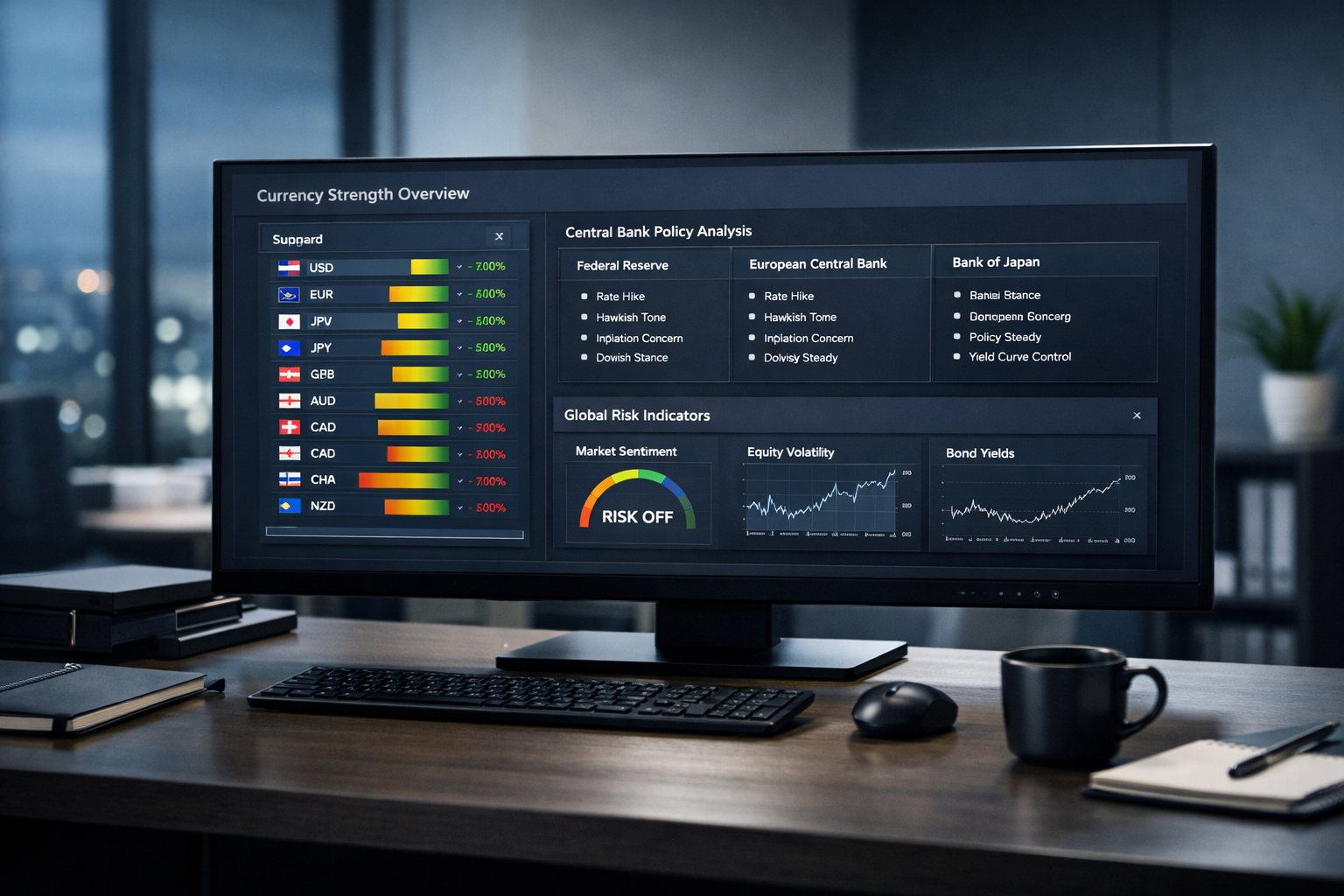
For most FX professionals, three factors drive the search for a Bloomberg Terminal alternative for forex traders. First, cost matters. Bloomberg pricing targets enterprise desks, not individual traders or lean prop environments. Second, complexity slows decision-making. Much of the terminal’s functionality adds no value to FX-only workflows. Third, inefficiency erodes conviction. Traders spend time navigating tools instead of analysing currencies.
As a result, demand has shifted toward platforms that preserve institutional macro logic while improving usability, speed, and relevance for FX decision-making.
What Bloomberg and Refinitiv Are Actually Designed For
Bloomberg and Refinitiv operate as enterprise-grade data ecosystems. Their core users typically include:
- Global investment banks
- Large asset managers
- Sovereign institutions
- Research and compliance teams
- Multi-asset trading desks
They excel at deep historical databases, broad cross-asset coverage, real-time news distribution, and highly regulated environments. However, forex traders operating independently or within prop firms rarely need this breadth. Instead, they need structured interpretation, not unlimited data.
Why Bloomberg Is Often the Wrong Tool for Active Forex Traders
For FX traders, Bloomberg’s strengths frequently become weaknesses.
Bloomberg treats FX as one asset class among many. As a result, traders must infer currency strength manually. Likewise, global risk regimes do not appear in a decision-first format. Central bank policy analysis also requires interpretation across multiple functions rather than being synthesised into a coherent FX framework.
In practice, traders pay for thousands of features they never use, data depth they cannot operationalise, and infrastructure designed for teams rather than individuals. Consequently, searches for a Bloomberg Terminal alternative for forex trading continue to rise.
What the Best Bloomberg Terminal Alternative for Forex Must Provide
The best Bloomberg Terminal alternative for forex traders does not attempt to copy Bloomberg. Instead, it solves the FX decision problem directly.
A credible alternative integrates the following components.
Macroeconomic Data Normalisation
Raw macro data alone does not create insight. Therefore, a professional alternative must normalise macroeconomic inputs so traders can compare countries meaningfully.
This process includes inflation, growth, and labour metrics on a comparable scale, trade and fiscal data weighted by FX relevance, and noise filtered from one-off releases. As a result, traders focus on trend and direction rather than data surprises.
Currency-Relative Strength Models
Bloomberg provides data. However, it does not provide FX-first currency strength frameworks.
The best Bloomberg alternative for forex traders clearly answers which currencies are fundamentally strong, which are weak, and why those conditions exist. Because FX is a relative market, currency-relative strength becomes the starting point of institutional analysis.
Central Bank Policy Divergence
FX trends emerge from divergence between central banks, not isolated decisions.
A forex-focused Bloomberg alternative therefore evaluates relative policy stance, forward guidance consistency, interest-rate expectations, and credibility versus inflation outcomes. This approach aligns analysis with how institutions interpret signals from the Federal Reserve, the ECB, the Bank of England, and other major central banks.
Global Risk Regime Analysis
Risk regimes determine whether macro fundamentals express themselves or become temporarily overridden.
Professional FX traders therefore require clear risk-on versus risk-off identification, cross-asset confirmation from equities, volatility, and yields, and early awareness of regime transitions. Bloomberg shows the data. A true Bloomberg Terminal alternative for forex interprets it in context.
Bloomberg Alternatives vs Trading Economics and MacroMicro
Many traders attempt to replace Bloomberg with platforms such as Trading Economics or MacroMicro. These tools offer value. However, they function primarily as data libraries, not decision systems.
Common limitations include the absence of an integrated FX workflow, limited currency-relative frameworks, heavy reliance on user interpretation, and minimal regime-level context. Consequently, a true Bloomberg Terminal alternative for forex must convert macro data into structured decision intelligence, not static charts.
Cost Comparison: Bloomberg vs Forex-Focused Alternatives
Bloomberg pricing reflects enterprise value. For most FX traders, this structure creates inefficiency.
By contrast, a professional Bloomberg alternative typically costs a fraction of a terminal subscription, focuses exclusively on FX-relevant intelligence, reduces analysis time, and improves consistency rather than information volume. Therefore, the relevant comparison is not cost per month. It is cost per decision error avoided.
Who Should Use a Bloomberg Terminal Alternative for Forex
A Bloomberg Terminal alternative for forex traders best suits professional independent FX traders, prop traders managing risk capital, portfolio managers with FX exposure, macro-focused swing and position traders, and traders transitioning to institutional-style workflows.
For these users, focus and structure consistently outperform breadth.
Common Mistakes When Replacing Bloomberg
Traders often replace Bloomberg incorrectly.
They swap one data source for another without changing workflow. Additionally, they prioritise raw data access over interpretation. In many cases, they underestimate the importance of global risk regimes. Finally, they expect automation instead of decision support.
The goal is not to replicate Bloomberg.
The goal is to replicate institutional thinking.
Final Perspective
Bloomberg remains an exceptional tool for institutions that need everything. Forex traders, however, do not need everything. They need the right macro intelligence, structured for FX decision-making.
The best Bloomberg Terminal alternative for forex trading delivers institutional-grade macro logic without institutional inefficiency.
That is not a compromise.
It is a strategic upgrade.
FAQs
Is there a Bloomberg Terminal alternative specifically for forex traders?
Yes. Several professional platforms focus specifically on macro context, currency-relative strength, central bank divergence, and global risk regimes for FX traders, providing a more practical alternative to Bloomberg’s multi-asset design.
Why is Bloomberg often unnecessary for forex trading?
Bloomberg is designed for enterprise, multi-asset environments. Most forex traders require focused macro interpretation, policy divergence analysis, and currency-relative frameworks, making much of the terminal redundant.
Can Trading Economics replace Bloomberg for forex traders?
Trading Economics is a strong macro data source, but it lacks integrated FX workflows, currency strength models, and regime analysis. It works best as a data reference rather than a full Bloomberg alternative for forex trading.
What defines the best Bloomberg Terminal alternative for forex?
The best alternatives provide macro data normalisation, currency-relative strength models, central bank policy divergence, and global risk regime intelligence within a structured FX decision framework.
Do professional forex traders still use Bloomberg?
Many institutional traders do, but an increasing number of professional and independent FX traders now use specialised platforms that replicate institutional macro workflows more efficiently.